 eskiu
eskiuWrite it like a script. Ship it like C.
A self-hosting systems language on LLVM, with explicit memory and direct C interop. One compiler for desktops, the web and phones.
Homebrew: brew install eskiu-lang/eskiu/eskiu · Windows and release archives

Why Eskiu
Native code through LLVM, with memory you manage and no garbage collector. A C library's structs and functions are called as they are, on every target.
C interop and ABIsSum types checked to the last case, nullable pointers checked before use, defer for cleanup, and bounds, overflow and null checks with --safe.
Run a file like a script, with HTTP, JSON, files and processes in the standard library, packages in one command and an editor that knows your code.
QuickstartRunning inside ViroReact.
ReactVision ships Eskiu in ViroReact: ≈85% less memory in its engine, the tracker behind its AR on the web, and its object detection on iOS and Android.
AR tracking in the browser
ViroReact's visual-inertial tracker runs on an engine written in Eskiu and compiled to WebAssembly. Its computer vision core computes the same bits as the C++ it replaced.
One detection core for iOS and Android
Object detection in ViroReact is one Eskiu core over ONNX Runtime on both platforms. On Android its JNI entry points are Eskiu too.
ReactVision case study → gpuLlama 2 on Metal
Llama 2 7B at 45 tokens per second on an M4 Pro, in WGSL over wgpu-native. llama.cpp gives 58 on the same machine.
Showcase → ReactVision
One language, from scripts to silicon.
Compile for the browser
One flag builds a page, a module, or a library for an existing emscripten project. Exceptions, async code and C interop work there as they do natively, and ViroReact's AR tracking ships to the web this way.
$ eskiuc app.esk --target wasm32-unknown-emscripten -o app.js
Phones
Static libraries for iOS and shared libraries for Android, called from Swift, Kotlin or Objective-C.
GPU and machine learning
WebGPU compute and 3D, ONNX Runtime and TensorFlow Lite, each one package away.
Scripts and command-line tools
eskiuc run or a shebang, with argument parsing, HTTP, JSON and processes built in.
Network services
async HTTP/1.1 and HTTP/2 servers over one event loop on Linux, macOS and Windows.
Bare metal
Freestanding builds with inline assembly and volatile access. An ARM64 kernel boots in QEMU.
Inside a C or C++ codebase
A module with a C header drops into an existing engine, one file at a time. That is how it entered ViroReact.
Familiar on the surface.
C's model of memory and data, with the checks and conveniences of a modern language, at no run-time cost.
Sum types, checked to the last case
An enum carries data per variant. Leave a case out of a match and it does not compile.
match parse_port("8080") {
    Port(p)         -> serve(p);
    InvalidRange(n) -> warn(n);
    NotANumber      -> fail();
}
Maths that reads like maths
Bounded generics are monomorphised; operator overloads resolve by operand type and compile to direct calls.
V3 operator +(V3 a, V3 b) { ... }
V3 operator *(V3 v, float s) { ... }

let mid: V3 = (a + b) * 0.5;
async, await and typed channels
One reactor on kqueue, epoll or WSAPoll: the same networking code runs on Linux, macOS and Windows.
async int sum_squares(Chan<int>* ch) {
    let a: int = await Chan_recv(ch);
    let b: int = await Chan_recv(ch);
    return a + b;
}
A standard library for scripts
Fetch over HTTPS, walk a directory, run a command, read JSON and CSV, with modules that ship with the compiler.
let r: Response;
fetch("https://api.github.com/repos/x/y", &r);
defer Response_free(&r);
println(JsonValue_as_cstr(json_get(
    Response_json(&r), "owner.login")));
The compiler is written in Eskiu too: the whole pipeline rebuilds itself to the same output through a three-stage bootstrap. How it bootstraps →
One eskiuc add away.
GPU compute and 3D, machine learning, compression, audio, fonts and JNI. A package that binds a C library brings it along: the first build downloads it and checks its SHA-256, so there is nothing else to install.
Browse the packages →$ eskiuc add onnx --git https://github.com/eskiu-lang/onnx --rev v0.1.0 added onnx (commit 550e8aba4d22) $ eskiuc run # src/main.esk imports <onnx> fetching onnxruntime for onnx from https://github.com/microsoft/... 1.31.0
Try it in the browser.
Edit the program and run it. The server compiles it with LLVM through the same eskiuc run.
STDOUT
Sandboxed: no network, time- and memory-limited, output capped.
Three steps to a running program.
-
1
Install
curl -fsSL https://eskiu-lang.org/install.sh | sh
Or
brew install eskiu-lang/eskiu/eskiu, or a release archive for Windows. -
2
Write
hello.eskimport <io>; println("Hello, Eskiu!");
A file with statements at the top level runs as a script; larger programs have a
main. -
3
Run it
$ eskiuc run hello.esk
Hello, Eskiu!
eskiuc hello.esk -o hellobuilds a native executable instead.
Free and online, from Hello, Eskiu to async and bare metal. Code that compiles with 0.12.0 keeps compiling in every 0.12.x (stability policy).
How far down it goes.
Experiments with what comes next, and with unusual hardware. Not products, and not all of them serious.
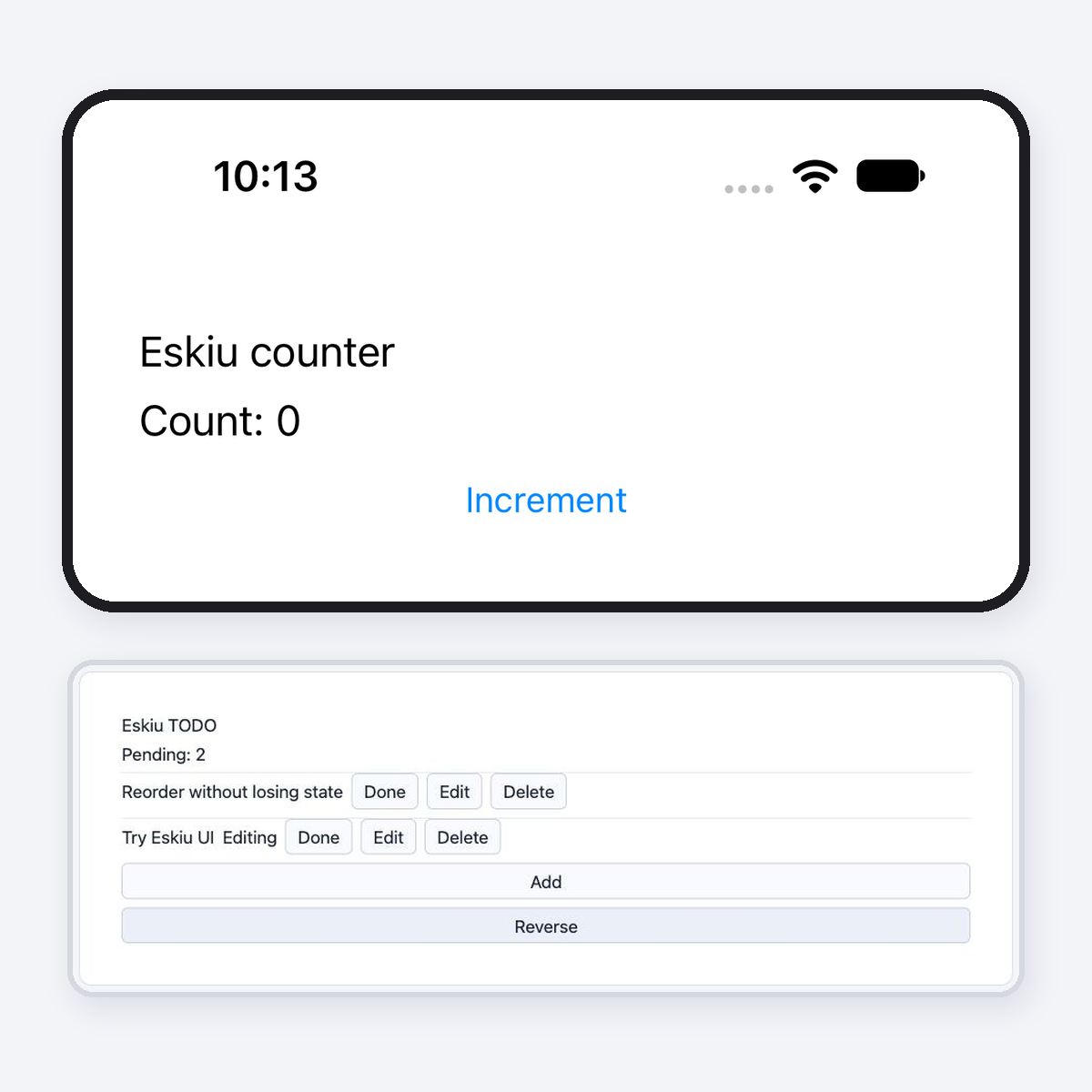
One UI for every screen
A reactive UI framework in Eskiu: the same components draw UIKit on iOS, native views on Android and the DOM through WebAssembly. A prototype of what 0.13 is building.
Source →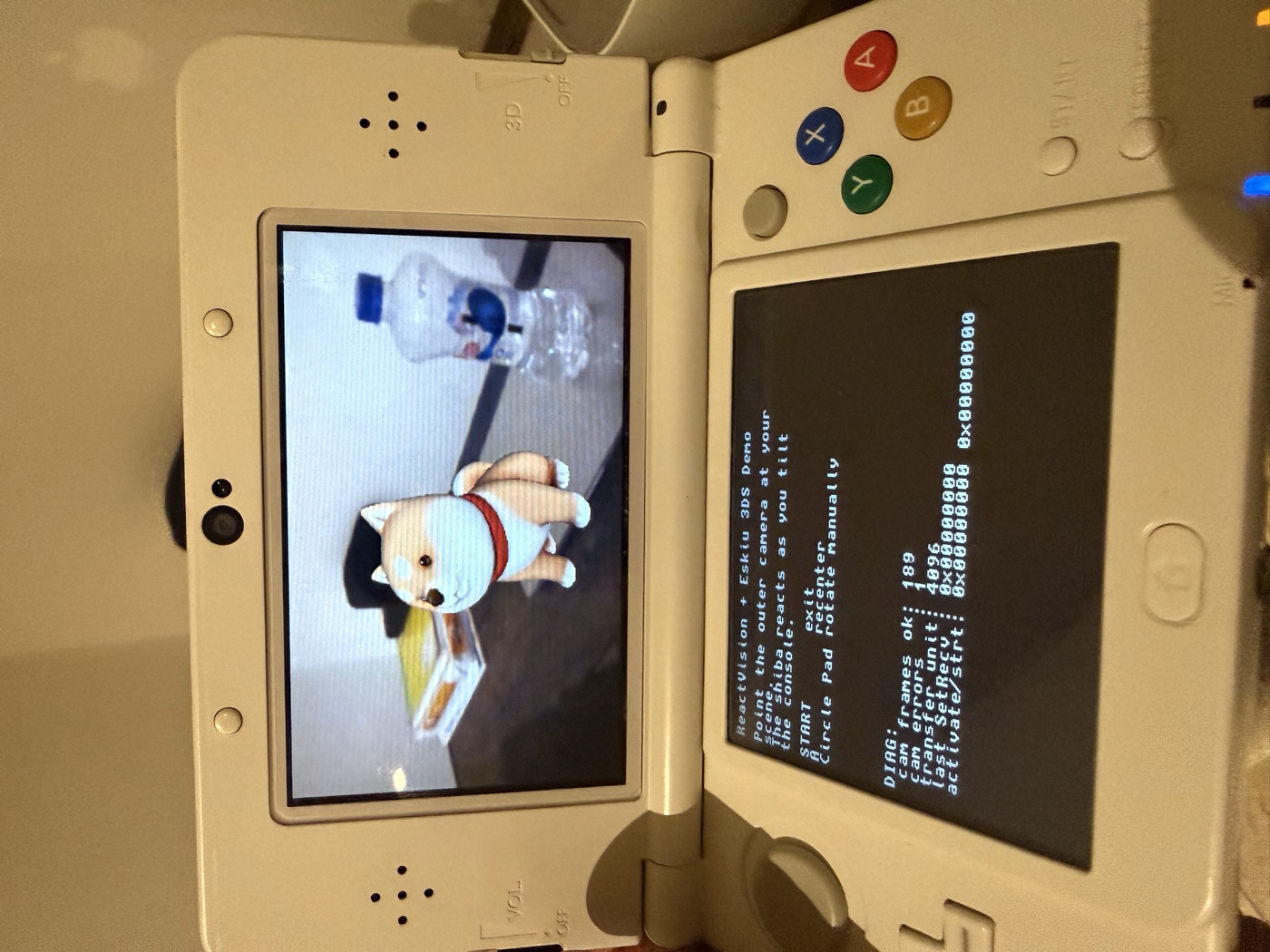
AR on a Nintendo 3DS
A camera-and-gyroscope AR demo on the 3DS's 32-bit ARM11, its logic in Eskiu and its rendering through ViroCore. Built for fun.
Case study →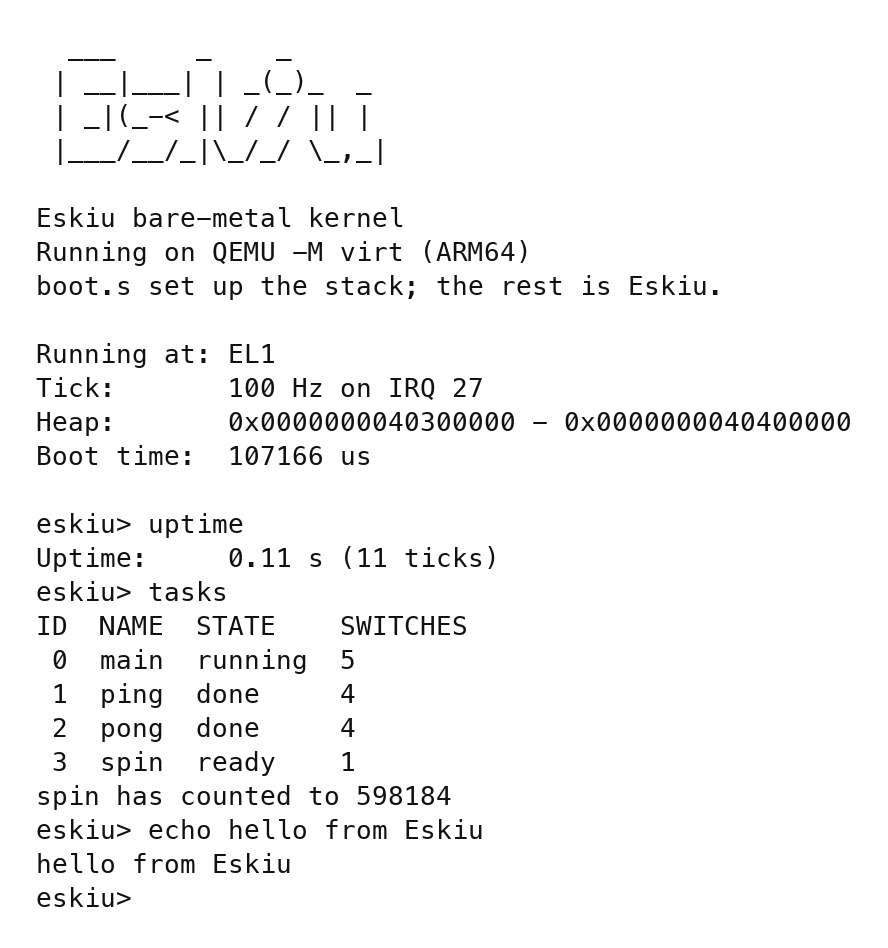
A bare-metal ARM64 kernel
Timer interrupts, a scheduler, a heap and a shell, booted in QEMU. A few lines of assembly set up the stack; the rest is Eskiu.
Source →A note from the developer
I learned to program with Ruby, but the more I built, the more I found C underneath everything, Ruby and Python included. I came to love its simplicity. Rust and Zig are well made, but for my work they always felt more complicated than they needed to be.
So I wrote the language I wanted: the simplicity of C, with the conveniences I kept reaching for in other languages. Today it builds itself and runs in production at ReactVision. If you build something with it, I would like to hear about it.

Eduardo DorantesCreator of Eskiu

Meet Tiny.
The kitten on every page is drawn from Tiny, the real one: paws on the table, watching what you type.